
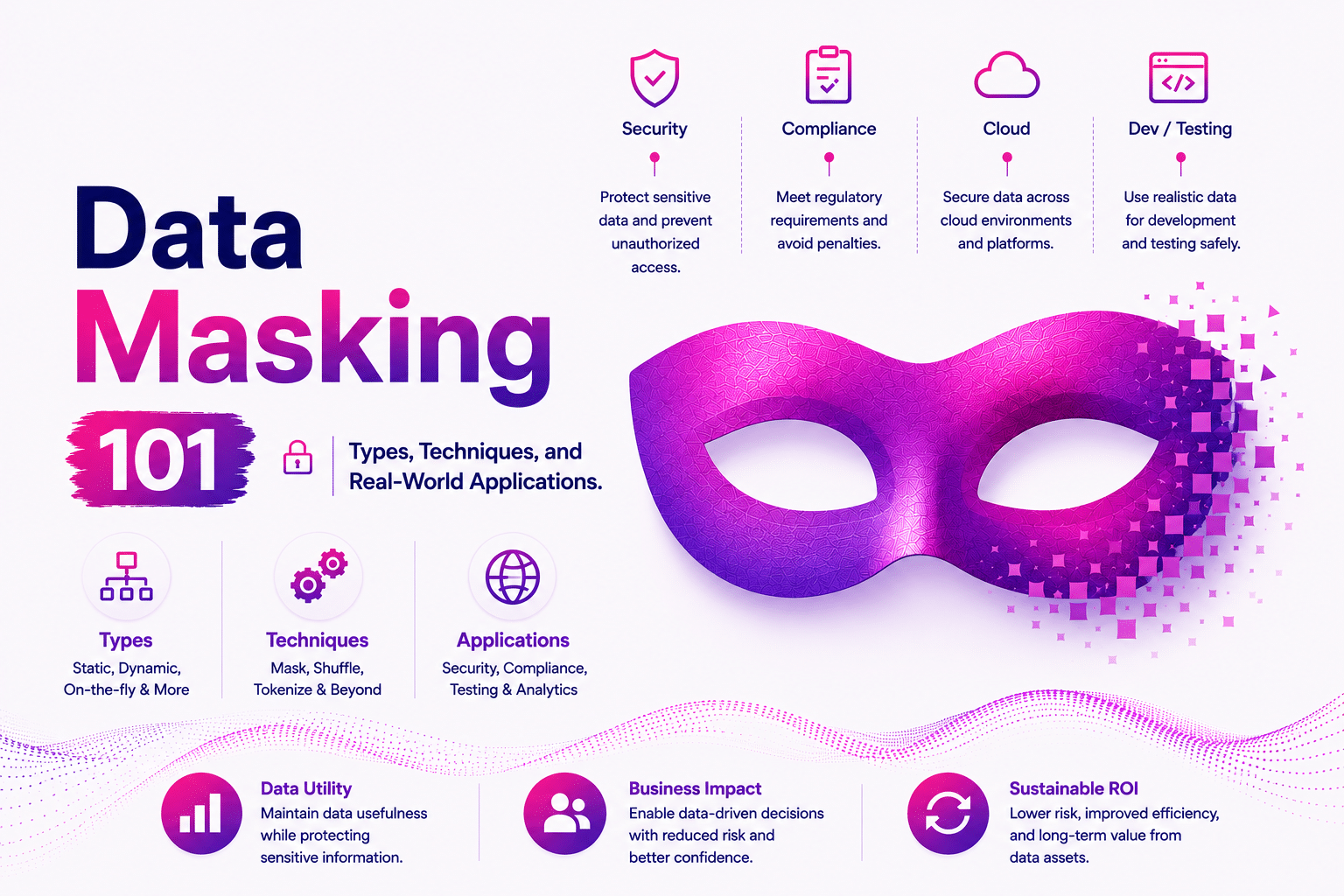
Organizations rely on data as one of their most valuable assets, but if left unprotected, it can quickly become one of their greatest liabilities. Companies use data masking which allows organizations to protect sensitive data while preserving its functional capabilities. This becomes even more critical in cases where data contains customers’ details or finances, as it provides a layer of security, while also allowing safe exchange of data.
Ultimately, it’s about balancing access with security.
How Data Masking Works
The method of data masking involves substituting confidential information with fictional information while maintaining the format of the original data to ensure that unauthorized users cannot view it. This technique involves keeping the data functional rather than destroying or making it unreadable since the aim is to maintain the integrity and usefulness; eventually allowing testing, training, reports, analysis, and applications development.
Types of Data Masking
Before selecting a method, it’s important to understand the different types and tools of data masking. These approaches define how masking is applied across various environments, while the techniques discussed later explain how individual data values are modified.
Static Data Masking (SDM)
Static Data Masking is a way to make a duplicate copy of data used in production. After the replacement of the data, a new copy becomes available for sharing with developers, testers, and training groups. Many tools such as Delphix, Informatica Dynamic Data Masking, and IBM InfoSphere Optim Data Privacy are commonly used to automate the creation of secure, masked datasets for non-production environments.
Dynamic Data Masking (DDM)
Dynamic Data Masking provides protection for sensitive information when accessing it. Based on user permissions, some people will be able to get complete records, while others will receive partially hidden data. To be able to implement this you might need tools such as Microsoft SQL Server Dynamic Data Masking, Oracle Data Redaction, and Imperva Data Security.
On-the-Fly Data Masking
On-the-Fly Data Masking makes data secure while being transferred from one system to another. As compared to Static data masking, a copy of data is not made. Data is simply masked during the transfer process.
Popular Data Masking Techniques
There are various techniques that businesses use to mask and protect data from any breach.
1. Substitution
This method entails substituting real values with fake ones that have the same form. For example, using fictitious customer names instead of the real names of customers.
2. Shuffling
It involves scrambling real values in a way where the information appears realistic but is not associated with the correct people. Using shuffling, organizations can ensure the protection of private data since it maintains the format and pattern of the data.
3. Character Masking
Here, a sensitive field is hidden in order to conceal some parts but not the entire data. An example would be showing the last four digits of a credit card number.
4. Randomization
Randomization entails creating new values that are unrelated to previous ones. The values maintain the same structure but are sensitive to information.
5. Nulling Out
This technique is useful where realism is not needed. Here, the realistic values are substituted with nulls.
Data protection strategies extend beyond masking techniques and should include defense against targeted attacks such as spear phishing.
Real World Data Masking Examples
In order to better understand how companies mask sensitive data without affecting its usability, here are a few data masking examples which can help you enhance your safety measures.
- Banks on their mobile app replace customer account numbers and balances with fictitious values.
- Hospitals provide masked data about their patients to researchers.
- An e-commerce company creates a copy of its production data in a test environment by masking customer details.
- A software company gets masked data about its clients from customers for the purpose of troubleshooting.
Challenges of Implementation
Despite its numerous security benefits, implementing data masking requires careful planning and continuous oversight. Some common challenges include:
Maintaining Data Quality
Poorly designed masking rules can reduce data quality, making datasets less reliable for testing, reporting, and analytics.
Preserving Data Relationships
Organizations must ensure relationships between interconnected records remain intact, so customer IDs, invoices, transaction histories, and other linked data continue to function correctly after masking.
Keeping Masking Policies Up to Date
Data masking should be treated as an ongoing process. As applications evolve, databases expand, and regulatory requirements change; organizations need to regularly review and update their masking policies to maintain effective protection.
Developing an Efficient Masking Strategy
Strategies include proper choice of technology and appropriate governance procedures.
Initially, it is necessary to discover sensitive information in databases, applications, and cloud migration and services. The next step is the classification of sensitive information based on sensitivity, value, and requirements of regulatory standards.
When choosing a solution, the following aspects should be considered:
- Scalability for huge amounts of data
- Automation of processes
- Support of cloud and hybrid environments
- Regulatory compliance
- Seamless integration into the system
- Centralized management of policies
Conclusion
Data protection has become a necessity for businesses. They need efficient solutions that minimize risks without impacting business performance. Using data masking techniques and analyzing data masking examples can help businesses utilize realistic datasets for growth.
FAQs
What is the difference between Data Masking and encryption?
Data Masking replaces sensitive values with fictional or concealed information, so the original data cannot be viewed in unproductive environments. Encryption converts data into unreadable ciphertext that can only be restored using an authorized decryption key. While encryption protects data at rest and in transit, masking safeguards information used for testing, development, analytics, and training.
What is the difference between Data Masking and tokenization?
Data masking conceals sensitive information while preserving realistic datasets for operational use. Tokenization , on the other hand, replaces sensitive values with unique tokens that have no meaningful relationship to the original data. The actual information is stored separately and can only be retrieved through authorized processes.
What is Data Masking in ISO 27001?
Within ISO 27001, data masking is recognized as a security control that helps reduce unauthorized access to sensitive information. Although the standard does not prescribe a specific masking technique, it encourages organizations to implement controls that strengthen information security and privacy.